Mathematical Reasoning
Number, measurement, space and problem solving, at genuine test difficulty.
For NSW parents of Years 3–6
Cognora prepares students for the OC and Selective High School Placement Tests across every section of the paper — and focuses their time on the topics they find hardest.
Free to start · No account needed
Three real questions from the free library — the same ones your child would see in the app. Answer one and you get the full explanation, not just a tick or a cross.
Try one now
1 of 13
The council says the community garden should be closed because its maintenance costs are too high. Since the garden is the only green space where neighbourhood children can play, closing it will significantly reduce the amount of outdoor activity they get. Which of the following, if true, most weakens the argument?
The argument assumes the garden is the only green space for children. Option A shows another park nearby, so closing the garden need not reduce outdoor activity — the assumption collapses. B and C describe other benefits and other programmes, neither of which touches the assumption. D disputes the cost claim, not the reasoning about green space.
A recent survey shows that only 5% of local residents visit Riverside Park each month. The council believes the land would be better used for new housing to address the town's shortage of homes. Therefore, the council should close the park and sell the land. Which of the following, if true, most weakens the argument?
The argument assumes that low visitor numbers mean the park has little value, justifying its sale. Option B shows the park has essential ecological importance, undermining that assumption and weakening the conclusion. Option A merely mentions more funding – it does not affect the park's value. Option C supports the idea that the park is underused. Option D reinforces the need for housing, which actually strengthens the council's plan.
Emma, the manager of a local bike shop, wants to know whether customers are happy with the new safety helmets. She asks the 80 customers who bought the new helmet last month to rate their satisfaction on a scale of 1 to 10. The average rating is 9.2, so she concludes that the new helmet makes all customers very satisfied. What is the main weakness in Emma's survey?
The survey only asked people who already bought the helmet, so the results cannot be generalised to all customers – the sample is biased. The sample size of 80 is reasonably large, the 1‑to‑10 scale is a standard clear measure, and there is no indication that respondents were pressured.
A school fundraiser sells two types of tickets. A standard ticket costs $2 and gives 1 raffle entry. A premium ticket costs $5 and gives 4 raffle entries. The school wants to raise exactly $27 and give out exactly 15 raffle entries. How many of each ticket must be sold?
Let s = number of standard tickets and p = number of premium tickets. Cost equation: 2s + 5p = 27. Entry equation: s + 4p = 15. From the entry equation, s = 15 – 4p. Substitute into the cost equation: 2(15 – 4p) + 5p = 27 → 30 – 8p + 5p = 27 → 30 – 3p = 27 → 3p = 3 → p = 1. Then s = 15 – 4·1 = 11. So the school must sell 11 standard tickets and 1 premium ticket.
Liam thinks of a number. He multiplies it by 3, adds 12, then divides the result by 2. If the final result is 21, what number did he first think of?
Work backwards, undoing each step in reverse order. Start at 21 and multiply by 2 to undo the division: 42. Subtract 12 to undo the addition: 30. Divide by 3 to undo the multiplication: 10. Option D is the trap — it is the value reached one step early, before the final division is undone.
A jar contains 2 red, 3 blue and 5 yellow beads. Two beads are drawn at random without replacement. What is the probability that at least one of the two beads drawn is red?
Step 1: Total beads = 2 + 3 + 5 = 10. The number of ways to draw any 2 beads is C(10,2) = 45. Step 2: Find the complement – the probability that no red bead is drawn. There are 8 non‑red beads, so the number of ways to choose 2 non‑red beads is C(8,2) = 28. Thus P(no red) = 28/45. Step 3: Required probability = 1 – P(no red) = 1 – 28/45 = (45‑28)/45 = 17/45.
A number machine follows a rule: it first multiplies the input number by 3, then subtracts 4 from the result. If the number 8 is put into the machine, what number comes out?
The rule involves two sequential steps: 1. First, multiply the input number by 3. Given input = 8 → 8 × 3 = 24 2. Then, subtract 4 from the result. 24 - 4 = 20 Therefore, the number that comes out is 20.
For a school fete, cupcakes are sold in boxes. Each box contains 3 chocolate cupcakes and 5 vanilla cupcakes. If a baker prepares 24 chocolate cupcakes, how many vanilla cupcakes will they need to prepare to fill the boxes?
Each box has 3 chocolate cupcakes. With 24 chocolate cupcakes, the baker can fill 24 ÷ 3 = 8 boxes. Each box also needs 5 vanilla cupcakes, so 8 boxes × 5 = 40 vanilla cupcakes needed.
In the saying "break the ice", the phrase most closely means:
The idiom is figurative: it describes easing tension and getting a conversation started when people feel uneasy. Option A takes the words literally, which is the mistake the question is testing. C and D attach a negative meaning the idiom does not carry.
The word 'crackling' (in line 8) tells us that the fire was: [Passage context: "When night fell, the fire crackling in the centre of the circle became our focus. The sound was steady, like a heartbeat..."]
The passage describes "the fire crackling in the centre of the circle" and adds, "The sound was steady, like a heartbeat." Therefore "crackling" describes a continuous, sharp sound. Option B is correct.
The word "bleak" in the passage suggests that the landscape felt: [Passage context: "Mawson's diary described the scene as 'a bleak landscape where the snow drifts seem to swallow the horizon'."]
"Bleak" here conveys desolation and hopelessness, matching option C. The other options describe feelings not aligned with the usual meaning of 'bleak' in this context of Antarctic exploration.
Why does the writer mention "the tide's gentle retreat" before describing the glow? [Passage context: "As the tide's gentle retreat pulls the water back over the sand, a faint shimmer begins at the shoreline..."]
The detail connects the retreat of the tide with the onset of movement that disturbs the plankton, triggering the bioluminescence. It does not state that glow is limited to low tide, nor does it suggest exclusive tourist access.
These five shapes can be put in order based on rotation. The shape rotates 45° clockwise each step. Which one is the middle of the sequence? (Imagine arrow shapes rotated at: 315°, 270°, 0°, 180°, 225°)
Put the five shapes in order of rotation: 315° → 270° → 0° → 180° → 225° (each step rotates 45° clockwise). The middle one (3rd position) is the upright arrow at 0° rotation.
Full breakdown across Thinking Skills, Maths & Reading. No account, no card.
What Cognora covers
Most apps cover Mathematical Reasoning and stop. Cognora covers all three multiple-choice papers of the Selective test — Reading, Mathematical Reasoning and Thinking Skills — plus the Abstract Reasoning used for HAST and scholarship entry. The Selective Writing paper needs human feedback, so we don’t pretend to mark it.
Number, measurement, space and problem solving, at genuine test difficulty.
Comprehension, inference and text analysis across fiction, non-fiction and poetry.
Logic, argument analysis and critical reasoning — the section most students have never seen.
Pattern and sequence recognition for HAST and scholarship entry.
How it helps
Questions adjust in real time to your child’s accuracy and speed, so practice stays challenging without tipping into overwhelm.
Wrong answers return later inside fresh questions — the same concept, a different wrapper — turning mistakes into lasting understanding.
Complete, timed papers that build exam familiarity and test-day confidence.
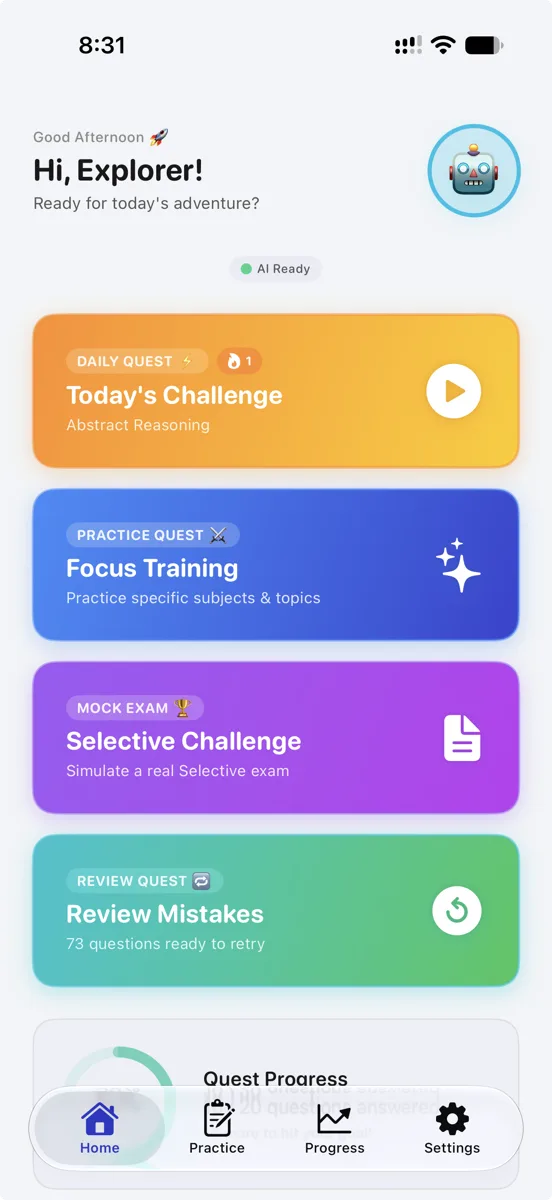
Accuracy, streaks, topics to focus on and score trends in one dashboard built for parents, not spreadsheets.
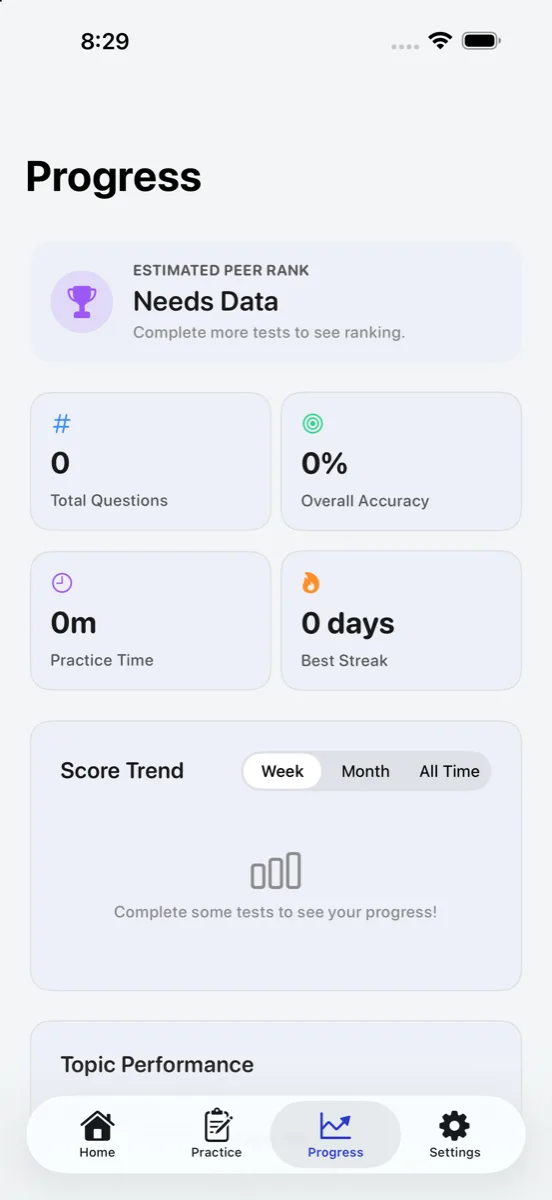
Cognora is on the App Store for iPhone and iPad. The question library, the daily challenge and the progress dashboard are free — no account, no card.
Free to start · Unlimited from $14.99/month · Cancel any time
On Android? There is no build yet — add your name to the list and it counts towards whether we make one.

Scan to open App Store